
Lactate Threshold: The Key to Unlocking Better Endurance Performance
· Fabio Abbruzzesi
If you’ve spent any time around endurance training, you’ve heard the term lactate threshold thrown around. It’s one of the most misunderstood — and most useful — concepts in physiology. Let’s clear it up.
Lactate isn’t the villain
For decades, lactate was blamed for the burning sensation in tired muscles. We now know that’s wrong. Lactate is a fuel, not a waste product. Your body produces it constantly, even at rest, and most of it is recycled by your liver and heart for energy.
The myth came from correlation, not causation: when you exercise hard enough that lactate accumulates faster than your body can clear it, other metabolic byproducts (especially hydrogen ions) start dropping muscle pH. That’s the burn. Lactate just happens to be the easiest thing to measure.
What “threshold” really means
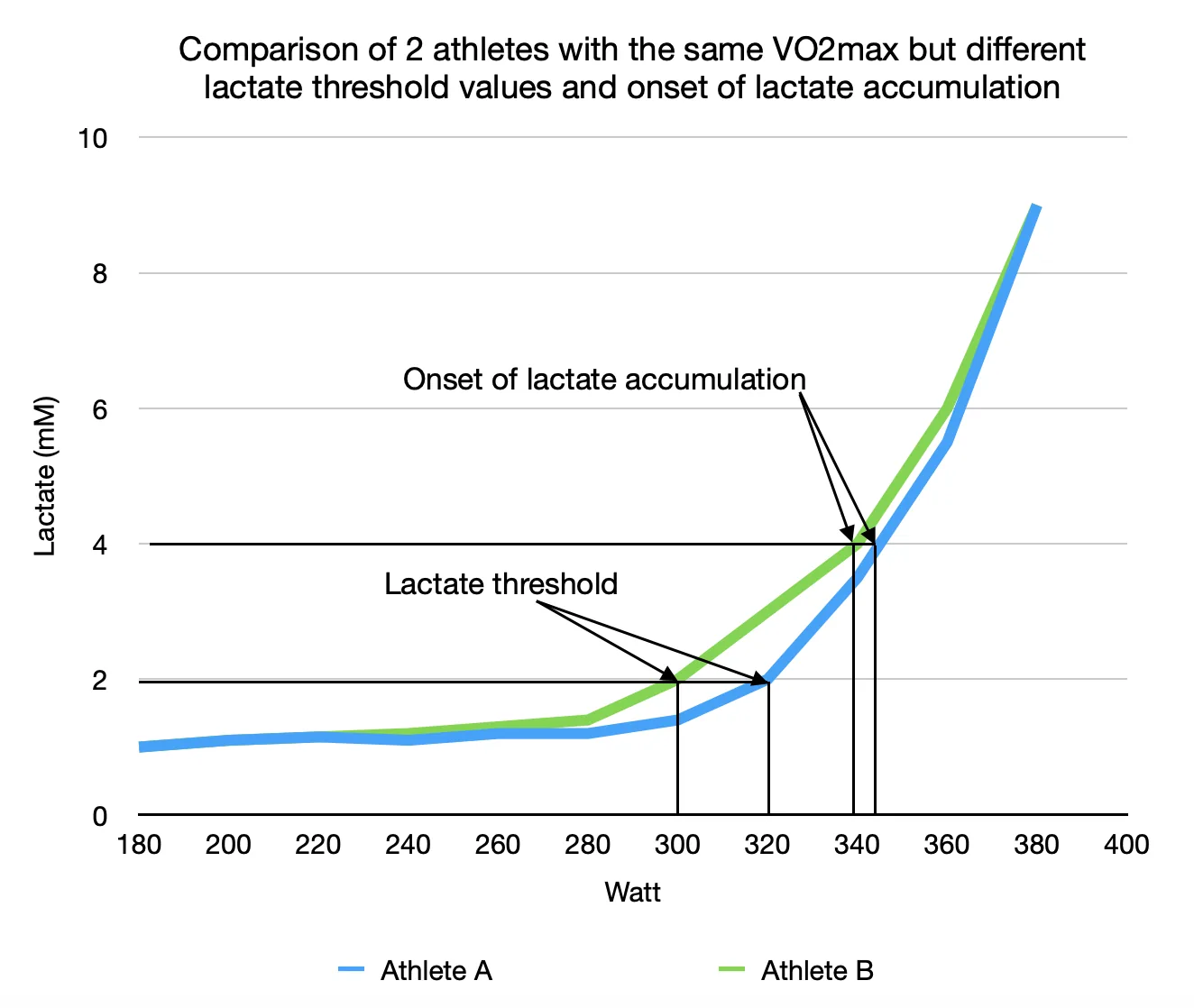
Your lactate threshold is the intensity at which lactate production starts to outpace clearance. Below it, your body is in a steady state — you could keep going for hours. Above it, fatigue accumulates rapidly.
Two practical thresholds matter:
- LT1 (aerobic threshold) — Just above easy pace. Lactate starts rising slightly above baseline. This is your “all-day” pace.
- LT2 (lactate or anaerobic threshold) — Lactate rises sharply. You can sustain this for roughly 40–60 minutes if very fit.
Most amateur runners train far too much between these two thresholds — the so-called “gray zone” — which builds fatigue without much fitness return.
How to find yours without a lab
Lab tests with blood samples are the gold standard, but you can get useful estimates from field tests:
- Talk test (rough LT1) — The fastest pace at which you can still hold a full sentence.
- 30-minute time trial (rough LT2) — Run as hard as you can sustain for 30 minutes (on a flat course or track). Your average heart rate for the last 20 minutes is a solid approximation of your LT2 heart rate.
These won’t be perfect, but they’re directional. And directionally correct beats precisely wrong.
Training to raise your threshold
The big insight: you raise your threshold both by spending lots of time well below it, and by doing focused work right at it.
A common weekly structure for an intermediate runner:
- 3–4 easy runs at conversational pace (well below LT1).
- 1 threshold session — e.g., 4×8 min at LT2 pace with 2 min recovery.
- 1 long run at easy pace, longer than your usual runs.
The easy runs build the aerobic engine. The threshold session pushes your ceiling up. Skipping the easy runs to do more “quality” work is the fastest way to plateau or get injured.
When to ignore the numbers
Thresholds shift week to week based on fatigue, sleep, life stress, and temperature. A heart rate that felt easy on Tuesday might feel labored on Friday. Trust your perception over the watch when they disagree — the watch doesn’t know you slept four hours.
The takeaway
Lactate threshold isn’t a magic number, it’s a useful concept. The two practical takeaways:
- Most of your running should be easy — well below LT1. Boring, but it works.
- A small dose of focused threshold work — once a week — does more than three “moderately hard” runs that fatigue you without forcing adaptation.
Simple. Not easy.